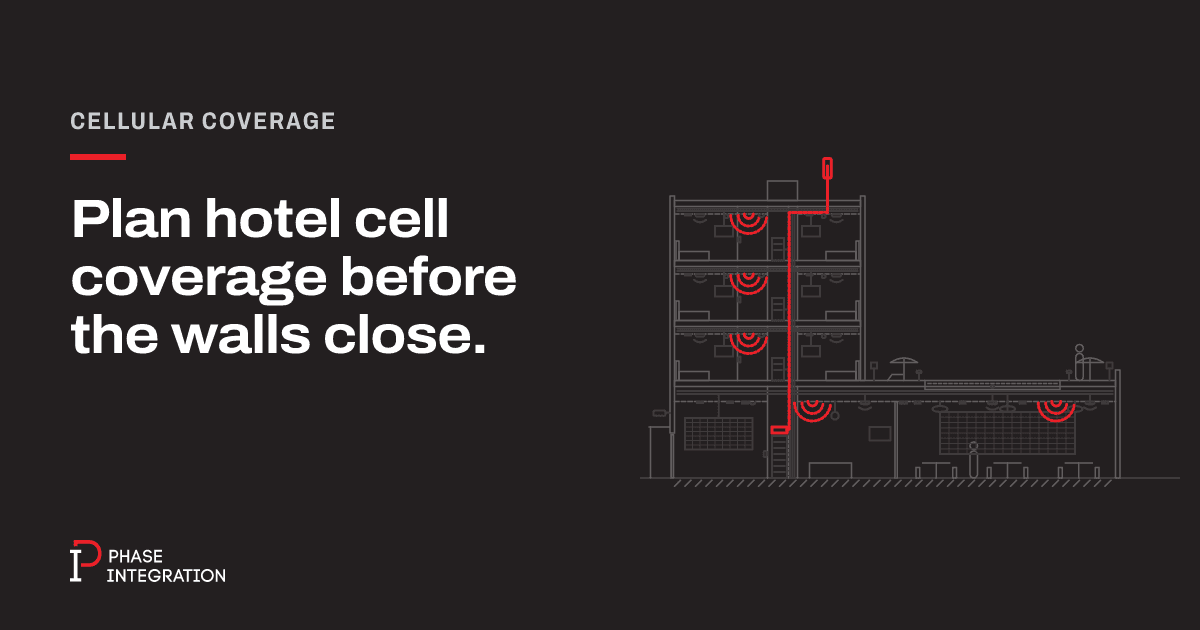
Hotel owners and developers should test cellular signal and plan any distributed antenna system (DAS) while the building is still open, because pathways, rooms and carrier approvals are far harder to add after drywall and finishes go in.
The best time to solve cellular coverage in a new hotel is before the walls close: test the signal at the shell stage, decide whether you need a distributed antenna system, and build its cabling, rooms and power into the construction schedule. Waiting until guests complain usually means opening finished ceilings, rerouting around other trades and paying for work twice.
A distributed antenna system (DAS) is a network of small indoor antennas, connected by cabling to a central head-end, that carries mobile carrier signal through a building. For hotels and resorts, it is often the difference between guests who can make a call from their room and guests who walk to the lobby to find a bar of signal.
Why do new hotels have poor cell signal?
New hotels often block cellular signal because of the materials that make them efficient and quiet. Concrete floors, steel framing, energy-efficient coated glass and dense interior walls all weaken signal coming from outdoor towers.
Hotels also have more hard-to-reach spaces than most buildings. Interior corridors, below-grade ballrooms, parking garages, fitness centers, spas, stairwells, elevators and back-of-house areas are common dead zones. A tower that looks close on a map does not guarantee coverage inside a guestroom on the far side of the building.
Why does cellular coverage matter so much in a hotel?
Cellular coverage matters because guests, staff and events all depend on it. Guests expect calls, texts and mobile check-in to work everywhere on the property, and poor coverage shows up quickly in reviews and complaints to the front desk.
Staff rely on phones and handheld devices for housekeeping, engineering, security and food and beverage service. Meeting and event planners notice when a ballroom or prefunction space cannot support attendees on their phones. Coverage is part of the product you are selling, not a back-office detail.
When should a hotel test cellular signal?
Test cellular signal as early as the building allows, ideally once the structure and exterior envelope are largely in place but before interior walls and ceilings are finished. A signal survey, where a specialist measures carrier signal strength and quality throughout the building, gives you real data instead of assumptions.
Before construction starts, a predictive model based on the drawings can estimate where coverage will be weak. That model helps you reserve space and budget early. The on-site survey then confirms or adjusts the design while there is still time to act.
What do you need to decide before the walls close?
Before the walls close, you need to settle where the DAS equipment, cabling and antennas will physically go. These are the decisions that are cheap on paper and expensive after finishes:
- Head-end room: a dedicated, conditioned space with power and backbone connections for the DAS equipment
- Riser and pathway space: room in vertical risers and ceiling pathways for DAS cabling alongside networking and other low-voltage systems
- Antenna locations: placement in corridors, public spaces and back-of-house that coordinates with lighting, sprinklers, speakers and the interior designer's ceiling plan
- Power and backup: circuits and, where needed, backup power for active equipment
- Access panels: points where equipment can be serviced later without damaging finishes
If these are not in the drawings, other trades will fill the space. Adding them later means cutting into finished ceilings in guest areas, which is disruptive and often visible.
Do you need a full DAS or will a signal booster work?
The answer depends on the size of the hotel, how many carriers you need to support and how weak the signal is. A signal booster is a simpler system that captures outdoor signal and rebroadcasts it indoors, and it can suit smaller properties with modest gaps.
Larger hotels, resorts and properties with significant event space usually need a DAS to cover multiple carriers evenly across many floors. Some DAS designs need carrier involvement and approval, which can take longer than owners expect. That is another reason to start the conversation during design rather than near opening.
What about public safety radio coverage?
Many jurisdictions require in-building radio coverage for firefighters and other emergency responders, often called an emergency responder radio coverage system. This is separate from guest cellular coverage, and it can affect your certificate of occupancy.
Ask your fire marshal or local authority having jurisdiction early whether it applies to your project and what testing they require. Planning public safety coverage alongside the cellular DAS lets the two systems share pathways and space where appropriate, instead of competing for them late in construction.
Who should own cellular coverage on a hotel project?
One team should own cellular coverage and coordinate it with every other low-voltage system. On many hotel projects it falls between the architect, the general contractor, the IT team and the brand standards, and nobody takes it on until the building is nearly done.
Cellular coverage shares risers with structured cabling, ceilings with Wi-Fi access points and speakers, and power planning with security and networking equipment. When one team designs these together, you avoid duplicated pathways, conflicting ceiling layouts and change orders between trades.
Common mistakes to avoid
The most common mistake is assuming coverage will be fine because nearby towers are strong. Other frequent problems include:
- Treating Wi-Fi calling as a full substitute for cellular coverage
- Forgetting garages, stairwells, elevators and back-of-house areas
- Leaving no room in the risers or head-end space for DAS equipment
- Starting carrier conversations too late for the opening date
- Ignoring public safety radio requirements until inspection
Frequently asked questions
When is the right time to plan a DAS for a new hotel?
Start during design, with a predictive model from the drawings, and confirm with an on-site signal survey before interior walls and ceilings are finished. That gives you time to build in pathways, equipment space and power.
Can we add cellular coverage after the hotel opens?
Yes, but it is usually more disruptive and costly because ceilings and finishes must be opened in guest-facing areas. Retrofit work may also have to be phased around occupied rooms and events.
Does Wi-Fi calling solve poor cell coverage?
Wi-Fi calling helps some guests, but it depends on device settings, carrier support and a strong Wi-Fi network. It does not cover every guest or staff need, and it does not address public safety radio requirements.
Is public safety radio coverage the same as a cellular DAS?
No. Public safety coverage serves emergency responder radios and may be required by your local fire authority, while a cellular DAS serves guest and staff mobile phones. They can be planned together but are separate systems.
How Phase helps
Phase Integration is a national workplace technology company. We plan, design and manage AV, networking and Wi-Fi, cabling, acoustics, lighting, cellular and security projects for hotels and resorts, offices, campuses and other commercial buildings across the country. On hotel projects, we join early, scope the signal testing, design cellular coverage alongside the rest of the low-voltage systems, and manage the specialist partners through opening and beyond. We're not tied to any brand, so we recommend the approach that fits the property. Every system, one project.