Skip to content
Services

Cellular DAS

High-performance cellular coverage, indoors

Distributed antenna systems that eliminate dead zones across offices, campuses, and large facilities.

RoofLevel 3Level 2Level 1

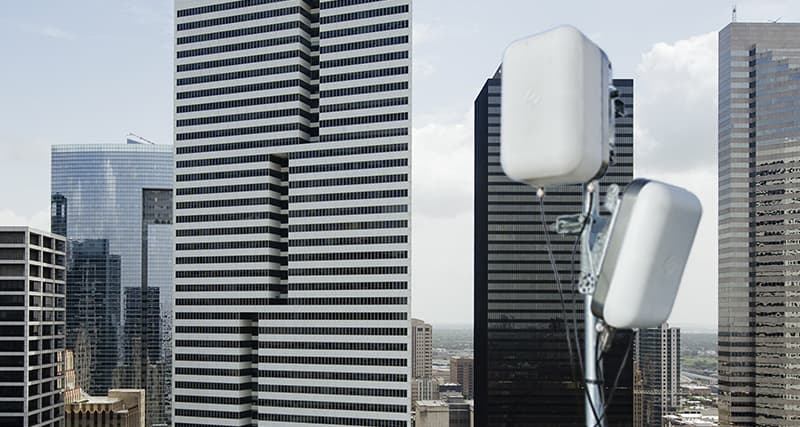
A rooftop antenna feeds indoor antennas, so phones work on every floor.

Dropped calls, slow load times, and unsent messages are what happens when a large building relies on the traditional cellular network alone. Concrete, steel, and low-E glass are excellent at blocking exactly the signals your people need.

Our experts design centralized in-building distributed antenna systems (DAS) with multiple remote antenna units for complete wireless coverage — improved network performance for video, data transfer, and bandwidth wherever you are in the building.

Who needs DAS

Offices, school campuses, apartment buildings, stadiums, hospitals, and corporate headquarters — any facility over about 10,000 square feet where reliable cellular service is a requirement, not a luxury. If Wi-Fi calling has become your building's unofficial phone system, it's time to talk.

Cellular DAS

DAS capabilities

  • 4G/5G distributed antenna systems
  • Coverage for buildings over 10,000 sq ft
  • Fiber or coax remote antenna units (RAUs)
  • Passive, active, and hybrid DAS designs
  • Carrier coordination and signal testing

What this covers

How a DAS Works

Concrete, steel, and low-E glass are excellent at blocking exactly the signals your people need. A distributed antenna system (DAS) fixes that by bringing the carrier signal inside: a centralized signal source feeding a network of remote antenna units throughout the building.

The result is strong, consistent cellular service on every floor — voice, data, and bandwidth that behave like you're standing outside on a clear day.

  • Centralized signal source + distributed remote antenna units
  • Consistent 4G/5G coverage on every floor
  • Fiber or coax distribution matched to the building
Cellular tower illustration

Passive, Active & Hybrid Designs

Not every building needs the same architecture. Passive DAS repeats and distributes existing signal — cost-effective for smaller footprints. Active DAS generates and distributes signal over fiber for large or complex buildings. Hybrids mix both.

We design to the building and the budget, not to a product line.

  • Passive, active, and hybrid architectures
  • Design driven by building size, materials, and budget
  • Scalable capacity for growth and 5G

Carrier Coordination & Signal Testing

A DAS project lives or dies on carrier relationships: rebroadcast agreements, signal-source decisions, and commissioning all run through AT&T, Verizon, and T-Mobile processes that punish inexperience.

We benchmark existing coverage, manage the carrier approvals, and test the finished system floor by floor so the coverage promised is the coverage delivered.

  • Pre-design signal surveys and benchmarking
  • Carrier rebroadcast agreements and coordination
  • Floor-by-floor commissioning and verification

Public-Safety Coverage

Many jurisdictions now require in-building coverage for first-responder radio systems as a condition of occupancy — a separate system from cellular DAS, with its own codes, frequencies, and survivability requirements.

We help you understand what your jurisdiction requires and design coverage that satisfies the fire marshal the first time.

  • First-responder (ERRC) coverage requirements
  • Code-driven design and AHJ coordination
  • Combined cellular + public-safety planning

Buildings That Need DAS

If Wi-Fi calling has become your building's unofficial phone system, it's time. DAS pays off in any facility over roughly 10,000 square feet where reliable cellular is a requirement: offices, hospitals, campuses, apartment buildings, stadiums, and warehouses.

We start with a signal survey. Sometimes the answer is a modest system, and we'll tell you so.

  • Offices, hospitals, campuses, residential, stadiums
  • Facilities over ~10,000 sq ft or with dense construction
  • Survey-first approach — the system you need, not the biggest one

Frequently asked questions

What is a distributed antenna system (DAS)?
A distributed antenna system is a network of small antennas inside a building that carries mobile carriers' cellular signal to every floor. It is fed by a signal source, such as an antenna on the roof or a carrier's own equipment, and distributed over fiber or coax.
How do I know if my building needs a DAS?
Dropped calls, slow data and people relying on Wi-Fi calling are the usual signs, especially in buildings over about 10,000 square feet or with concrete, steel or low-E glass. A signal survey measures coverage floor by floor and shows where it falls short.
Is a DAS the same as a cell phone signal booster?
No. A consumer booster suits a small space. A DAS is engineered for large buildings and campuses, covers several carriers, and is designed and tested to deliver consistent coverage and capacity across the whole building.
Do mobile carriers have to approve a DAS?
Yes. A system that rebroadcasts carrier signals needs the carriers' approval, so their requirements and timelines are part of the plan from the start. We coordinate with the carriers and test signal levels before handover.

Tell us what you’re planning.

A new office, a hotel renovation, or systems that don’t work the way they should. Tell us about it and we’ll come back with a plan.