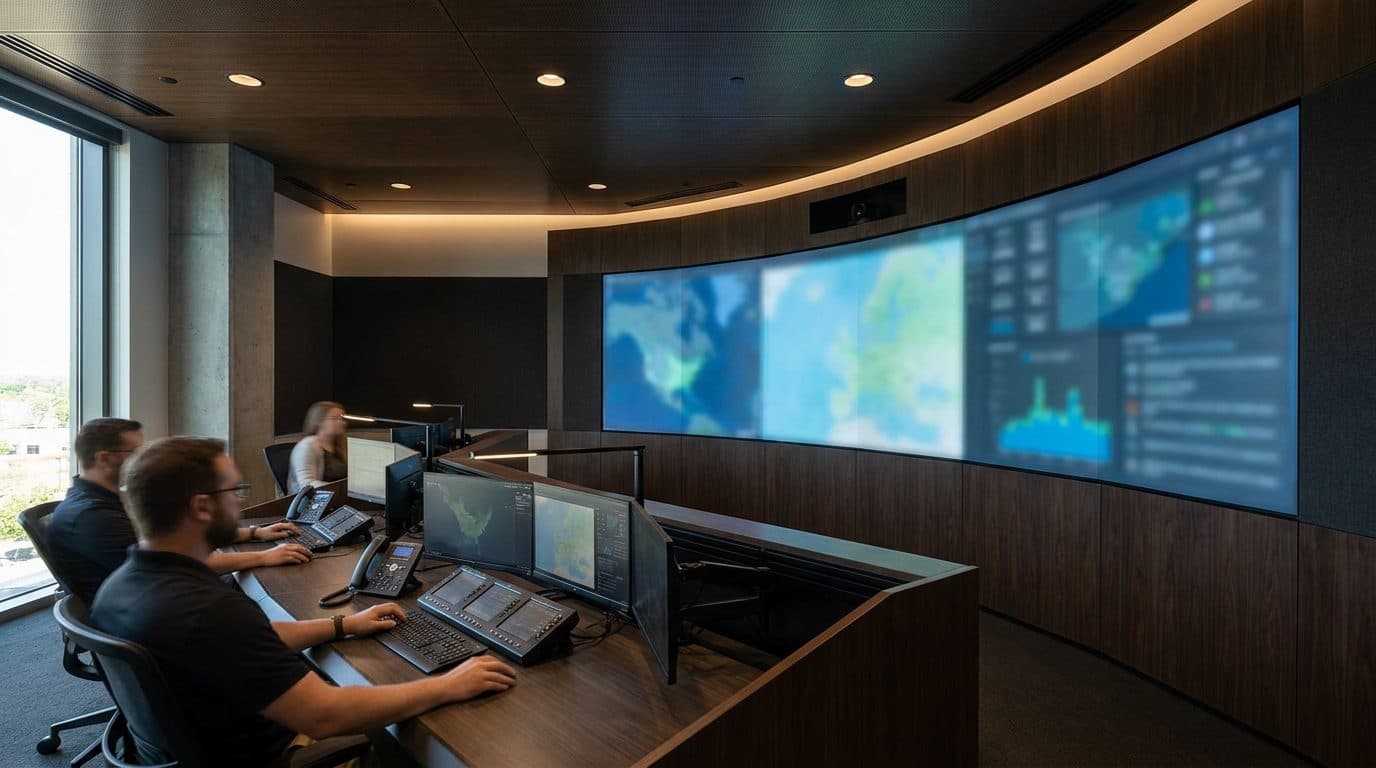
An LED video wall in a dispatch, network or operations center needs structure, power, cooling, network design, lighting, acoustics and long-term support planned together. Here is what to plan, what to ask and where projects usually go wrong.
Planning an LED video wall for an operations center means designing the display, the wall behind it, the power and cooling, the network, the room's lighting and acoustics, and the support plan together, before anything is ordered. The screen is the visible part, but most of the risk sits in the systems around it.
This matters most in rooms that never close: dispatch centers for trucking and rail, network operations centers, security operations rooms and trading-floor monitoring walls. If the wall goes dark, people lose the shared picture they work from.
What is an LED video wall?
An LED video wall is a large display built from modular cabinets of light-emitting diodes, joined into one continuous image with no visible seams between panels. A video processor, the device that takes multiple sources and arranges them on the wall, decides what appears where.
Unlike a grid of flat-panel LCD displays, an LED wall has no bezels, the thin frames that break up an image. That makes it well suited to maps, track diagrams and dashboards that span the full width of the wall.
How do you choose the right pixel pitch?
Pick pixel pitch based on how close the nearest operator sits and how small the text on the wall will be. Pixel pitch is the distance between the centers of neighboring LEDs, measured in millimeters; a smaller number means a sharper image up close and a higher cost.
Operations walls often show small text: unit IDs, alarm labels, ticker data. A pitch that looks fine for a lobby display can make that text unreadable from the first row. We recommend viewing sample cabinets at the real seating distance with your own content before deciding.
Is LED always better than an LCD video wall?
No. LED fits large walls, bright rooms and continuous imagery, while LCD video walls can still fit smaller rooms where operators sit very close. The right answer depends on room size, viewing distance, content and how the wall will be serviced.
Because we're not tied to any brand, we compare options side by side on fit, service access and long-term support, not on which product line we happen to sell.
What does the wall need from the building?
The wall needs structural backing, dedicated power, enough cooling and a clear plan for service access. These belong in the architect's and engineers' drawings, not in a late change order.
- Structure: LED cabinets are heavy, and the mounting system needs a wall or frame rated for the load.
- Power: dedicated circuits sized for the wall, with a decision on UPS backup for rooms that run around the clock.
- Heat: the wall and its equipment rack add heat load the HVAC design has to account for.
- Service access: front-serviceable cabinets let modules be swapped from the room side; rear access needs space behind the wall.
- Depth: the wall plus mount takes room depth that affects furniture and sightlines.
How does the video wall connect to the network?
The video wall depends on the network to reach its sources, so the network design and the wall design need to be done together. Camera feeds, dispatch software, dashboards and remote desktops all travel across it.
Ask your IT team early about network segmentation, security standards and who will manage the processor. A wall built to your IT standards is one your team can actually run and patch. For critical rooms, plan redundant processors and power paths so one failure doesn't take down the whole display.
Structured cabling matters here too. Cable pathways from the rack to the wall, and from source equipment to the rack, should be drawn before walls close.
Why do lighting and acoustics matter in a control room?
Poor lighting and acoustics make a good wall harder to use. Glare from windows or downlights washes out the image, and a room full of hard surfaces makes radio and phone traffic hard to hear.
Lighting controls that dim specific zones near the wall, shades on windows, and indirect fixtures over workstations all help. On the acoustic side, absorptive panels and, where needed, sound masking keep conversations from carrying across the room.
How long does an operations center video wall take?
Timelines depend mainly on design approvals, equipment lead times and how much of the room can be taken offline. LED lead times vary by manufacturer and configuration, so confirm them before you set a cutover date.
Budget time for these stages:
- Discovery: how operators work, what they watch and what must stay visible at all times.
- Design and structural review, coordinated with the architect and engineers.
- Submittals and procurement.
- Installation, then calibration so brightness and color match across every cabinet.
- Commissioning, content layout and operator training.
For centers that can't close, plan a temporary display setup or a phased cutover during a low-activity window.
What are the most common mistakes?
The most common mistake is treating the wall as a display purchase instead of a room project. Others we see often:
- Choosing pixel pitch from a spec sheet rather than real content at real distance.
- Leaving heat load and power out of the MEP design.
- Skipping spare modules from the same production batch, which makes later color matching harder.
- No plan for who supports the wall at 2 a.m.
What support does a video wall need after handover?
A video wall needs preventative maintenance, firmware updates, spare parts on hand and a clear way to get help. For 24/7 rooms, remote AV support lets technicians check the processor and sources without waiting for a site visit.
Keep the as-built drawings, settings and spare inventory in a closeout binder so anyone on shift knows what's installed and how to report a problem.
Frequently asked questions
Can an existing room take an LED video wall?
Often yes, but confirm wall structure, power, cooling and room depth first. A site visit and drawings before a quote will show what the room needs.
Should we buy spare LED modules?
Yes. Spares from the same production batch make replacements match the rest of the wall in color and brightness.
Who should own the video processor, IT or facilities?
Decide during design. Because it sits on the network and handles live sources, many organizations give IT ownership with facilities handling the physical wall.
Can the wall be installed while the center stays live?
Usually, with a phased plan, temporary displays and a cutover scheduled for a quieter period.
How Phase helps
Phase Integration is a national workplace technology company. We plan, design and manage AV, networking and Wi-Fi, cabling, acoustics, lighting, cellular and security projects for offices, hotels, campuses and other commercial buildings across the country, from our headquarters in Jacksonville, Florida. For operations centers, we scope the wall, coordinate structure, power, network, lighting and acoustics with your design team, manage the specialist partners through cutover and support the room after handover. Every system, one project.